
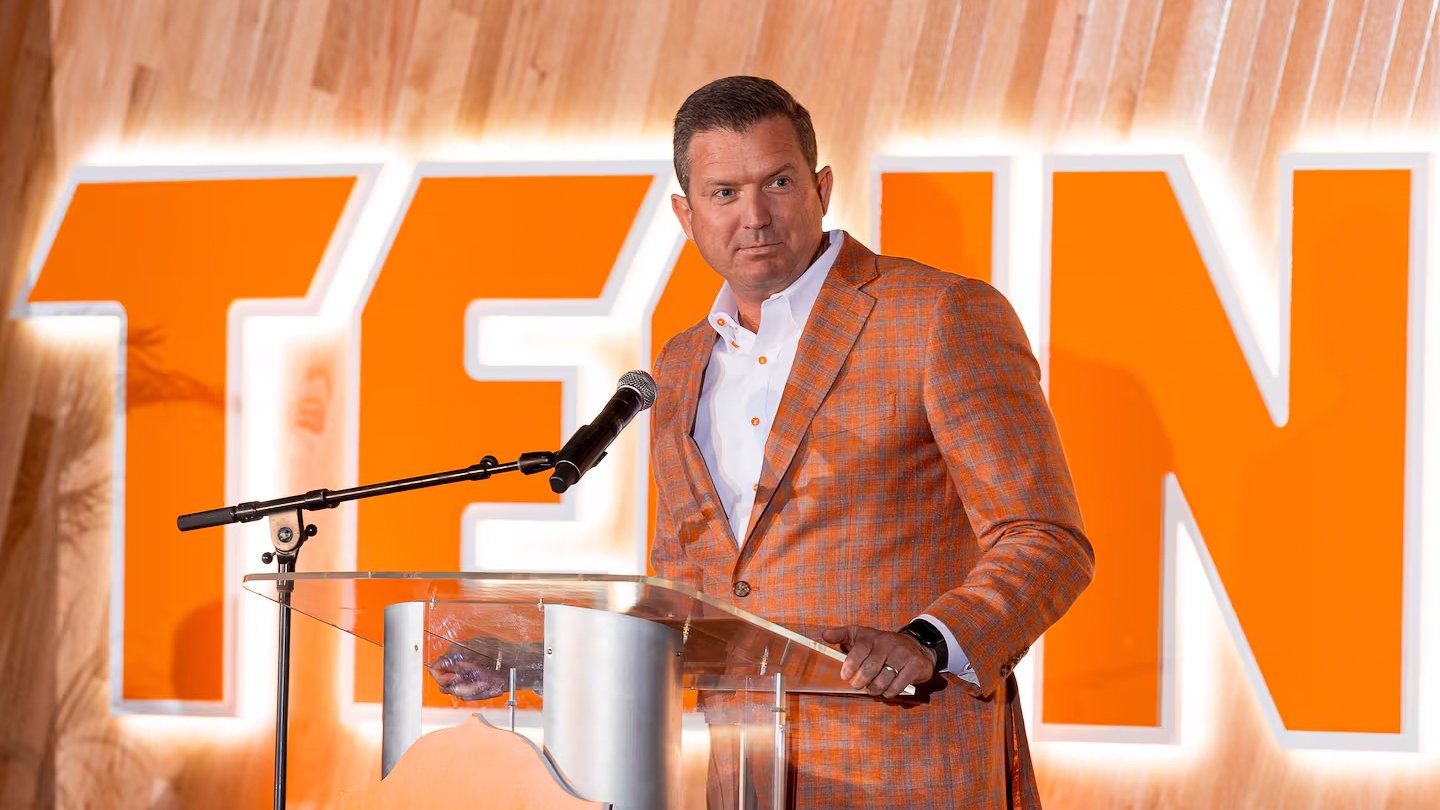

Tennessee athletics director Danny White joined the Mike Keith Show ahead of the Vols’ second home game of the season, reviewing game-day security, traffic and stadium changes after the opener. Kickoff against Kennesaw State is set for 7:45 p.m. Saturday, the first night game of the year at Neyland Stadium.
White spoke in great detail about these aforementioned topics, and even went into the demand for Tennessee football tickets. Could Neyland see more seats someday? It seems to be the only way to solve some of the demand. Below is everything Keith and White discussed on the show.
Q: The secure perimeter around the stadium, how long has that been in place? The NFL did it five or six years ago. When did it come into college?
White: “We started it in 2021, which was my first season here, and I think conference wide it was a push to do it a couple of years before that. But then COVID hit and slowed some things down, and it’s expensive. We invested millions of dollars in the mags, as they call them, the walk-through security screeners that are intended to speed things up and make it more efficient. What they’re really looking for is things that can harm people. They’re not out looking for your phone or your car keys. And Neyland presents a really challenging footprint.
“We’ve tried to screen right up to the gates, and that created a mob scene. Now we’ve extended the secure perimeter further away from the stadium. We think it’s the best way to tackle the very challenging footprint that is our stadium. As awesome as it is to have that location right in the middle of campus and right next to the river, it does create some challenges. So I think we’re really close to a solution that makes sense, and most importantly, a safe and secure environment for 102,000 people.”
Q: How did it go in game one?
White: “There are some great success stories. The extended perimeter at the top of Peyton Manning Pass worked great. We learned a couple things. We had some choke points that we’re going to solve. So we’re adding entry points at the base of G5/30, that parking lot where it hits Phillip Fulmer Way closest to the stadium, because people were trying to walk that way. They see the stadium and it was a dead end, and we’ve learned that that’s not a winning solution. So we’re adding 10 mags there. And then the same thing in Lot 9, where people can leave from Lot 9 and get to Peyton Manning Pass. Similarly, people can go through the security screening at the top of Peyton Manning Pass and then leave it if they want to go back to Lot 9 and then come back through.
“So some of it is for our fans to get used to what a secure perimeter does, and for us to create. I think the adjustments we’re making for this weekend create optionality at every point. You don’t have to be stuck in the secure perimeter. Once you’re in, you can walk back out and walk back in. The goal of it is to reduce the congestion closest to the gates, and we saw great success with that. I got a screenshot of Gate 21 five minutes before kick last week, and it was a ghost town.”
Q: When you say mags, you’re putting more screening machines in place at these spots?
White: “We are. We’re going from 35 to 60. Let’s over-program it, if that’s what it is. The goal is to really minimize congestion and buildup of lines so people can get through. We know that the stadium is safe and secure, and hopefully it doesn’t create too much of a hindrance on where they want to go out and about. Our fans are social. They like to go to this parking lot and see some folks, go over here, maybe go several different places before they walk in the stadium.”
Q: The difficulty with the campus is that everything happens toward the west side. If you’re coming from campus, going to the Vol Walk, going to watch the band, you’re on the west side. Is that what you mean by the challenge of the campus environment?
White: “It is. And the topography of our stadium, the east side is way down the hill. The vast majority of 102,000 people are coming through one side of the stadium. That’s why we expanded that southwest corner, the southwest plaza, and expanded those gates, expanded the south concourse, so that can be a better conduit for people to get to the east side. I think all of those things should help a lot, but extending that perimeter like we’ve done this year was needed to avoid the congestion at the bottom of Peyton Manning Pass that we saw last year. We just didn’t have enough options for people to get through it in game one, and we’re fixing that for game two and beyond.”
Q: Let’s talk traffic. A lot of work went into the plan after the concert and the Savannah Bananas game in May. How did all that work?
White: “I think it worked really well. Having multiple lanes of traffic heading west on Cumberland and on Neyland Drive for the first time took great coordination with a lot of different police units, starting with UT police and city, county, multiple counties. It takes a lot of first responders to put on a game at Neyland Stadium, and I think we had good early reports. That game wasn’t the best test for egress, because people were leaving and trickling out throughout the second half. We need to be prepared for times when 100,000 people all want to leave at the same time. And I think we are. A reasonable goal, but an aggressive goal for us, is to try to empty campus in under an hour. That’s a tall order with that many people, and there’s not a lot of roads.
“As you know, we spent a lot of time and resources on this plan, and if everyone follows the plan, including our fans, and that’s why we’re communicating and over-communicating at times. If you park in this lot, this is how you should come and this is how you should go home. There’s 102,000 participants in this playbook, and just like on a football field, if one player doesn’t do their job, it messes the whole thing up. The route may not be how you normally drive. We’re asking you to follow the playbook, and then it’s on us to make sure that it works, and we’ll continue to monitor it. And if we need to tweak it, we will.”
Q: Neyland into Kingston Pike is a game changer.
White: “No question. We had to adjust that exit ramp to get up onto the interstate, so we have two lanes of traffic going onto the interstate, which doubles the speed at which we’re empty, and Neyland Drive, which should double the speed at which we’re empty, and the parking lots behind it. It’s a trickle-down effect.”
Q: The cooperation is almost unheard of. UT police, KPD, Visit Knoxville, city, county, everybody involved. Coming up with the plan and having all these people execute it together is unusual.
White: “It’s the best coordination, from what I understand, we’ve ever had. They’ve been awesome. We’ve had great partners across the board, and a lot of that is because of the impact our fans make on this community. The economic impact of game days is astronomical for the city, for our campus, for everyone involved, and we want people to have a great experience. I know they wouldn’t want to go to some new stadium built out in the suburbs, surrounded by surface parking lots. They love Neyland Stadium. We all do. It’s iconic. It’s the cathedral of college football. I think we all need to understand, and I think our fans do, that it does present some challenges with the location and the footprint, but I feel really good about all the work that’s gone into it and the plan we have for this season.”
Q: What was the reaction to the new sound system in the stadium?
White: “I think people really liked it. I was impressed. It was certainly expensive. It is the best solution in the world for a stadium that size. I think it delivered.”
Q: Speaking of the fans, what about the takeover of Atlanta last Saturday night? Were you even surprised by that?
White: “I can’t even say I’m surprised anymore. It’s just been so many events away from Knoxville that just turned into a sea of orange. I think about the Mississippi State game on the road last year. This was a lot like that, maybe even a bigger percentage of the stadium. They find a way. And another part, I think, is Neyland Stadium has gotten so hard to get into. So I think for some fans it’s an opportunity to see the Vols in person where it’s a challenge just to get into our home stadium. We have 29,400 accounts on a waiting list. We averaged three and a half tickets an account. The passion is really, I think, unparalleled.”
Q: The 29th consecutive sellout is coming up. When you started this five years ago, you reached goals much more quickly than the five-year plan.
White: “No question. I underestimated Vol Nation for sure.”
Q: The passion was always there, but things were not good for a while and lost momentum, and then suddenly it’s come back in a dramatic way. With 29,000 people on the waiting list, do you keep looking at options to get them in the stadium?
White: “We’d love to. I think the only place to do it is in that north end zone, if we were going to add seats. And beyond that waiting list for season tickets, we also have on average about 20,000 students, and we only have 12,000 seats in our student section. About 20,000 want to come, so we need more student seats. I’d love to have more seats for season ticket holders. It would also maybe help drive down the secondary market a little bit if we add a little more supply. I was a marketing major, but I took econ. Maybe we could help a little bit with that. But it’s certainly not a quick and easy project.”
Q: Thanks for bringing us up to speed on week two. More mags, 35 to 60 on the perimeter. Traffic plan went well. Follow the plan, don’t try the shortcut.
White: “I’ll interject real quick. It went well. From a macro stance, if you had a bad experience and we know about it, which I think we do, whether we observed it ourselves or heard from people, it’s really helpful for folks to tell us if the staff working a specific intersection isn’t following the plan. We had a couple minor issues. They weren’t minor for the people that were involved. It’s never minor. We want to get it perfect, but in the scope of it, we had a few issues that are being resolved. By and large, the ingress and egress worked great.”